
Has the Indian Press Lost Its Voice?
For me, the press is one powerhouse that can change the fortune of a country—if it does its job correctly. However, the trends I have been seeing in my country over the past few years have been deeply disturbing. In fact, far more disturbing than I can express.
I am someone who takes a keen interest in politics and anything that can help the country progress.
A Disturbing Shift in Indian Media
Over the past few years, we have been witnessing disturbing scenes of media houses being bought or controlled by a handful of powerful interests that seem to have an evident inclination towards a particular political party.
When almost every news channel appears to carry the same narrative, people naturally begin looking elsewhere for information. Today, many ordinary citizens are turning to social media for what they believe is more authentic news. Increasingly, it is the common man with a mobile phone who is reporting events happening right in front of them, filling the gap left by mainstream media.
What Makes a Healthy Press?
In my opinion, a healthy press is one that represents every section of society. It should cover different viewpoints, give space to opinions both for and against an issue, and ensure that every section of society has someone speaking on its behalf. Above all, it should have the courage to question those in power, regardless of which political party is in government. Journalism is not about defending those in authority—it is about holding them accountable.
That, to me, is one of the greatest strengths of a democracy.
When Journalism Was a Calling
I grew up hearing about journalists who were willing to put their lives on the line while steadfastly holding on to the ethics of journalism.
Of late, however, much of the media seems to have become a cacophony of shouting matches and endless debates over less important issues, while people continue to die because of far more serious problems.
The Silence That Troubled Me
For almost two years, I hardly saw mainstream media giving sustained attention to the violence in Manipur. I often wondered how the press could remain so quiet when people were dying. I found it difficult to understand why such a humanitarian crisis wasn’t receiving the sustained attention I expected. Amid all the noise, how could they behave as though everything was normal?
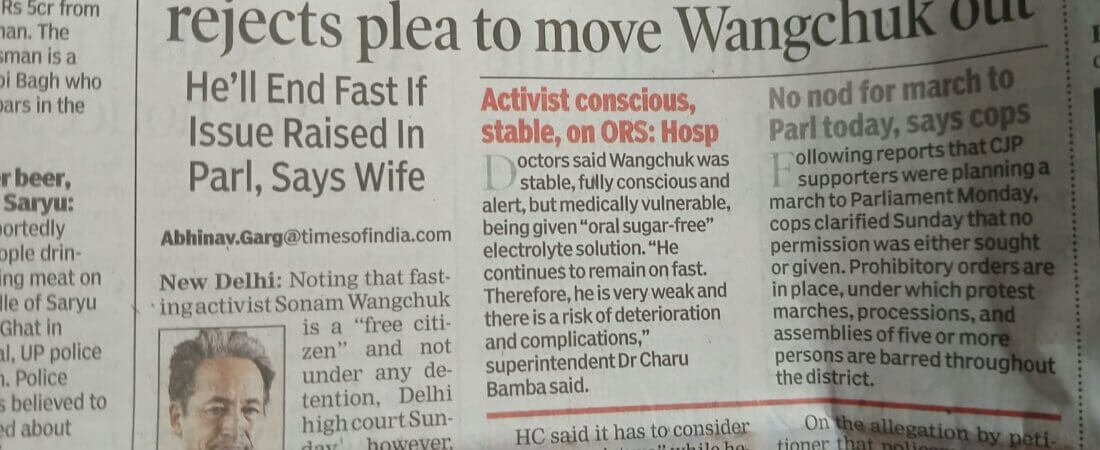
For days, there was also very little reporting on the hunger strike by Sonam Wangchuk, a renowned activist, innovator, education reformer, and environmentalist. If a Ramon Magsaysay Award recipient can be overlooked so easily, imagine who will listen to the common man.
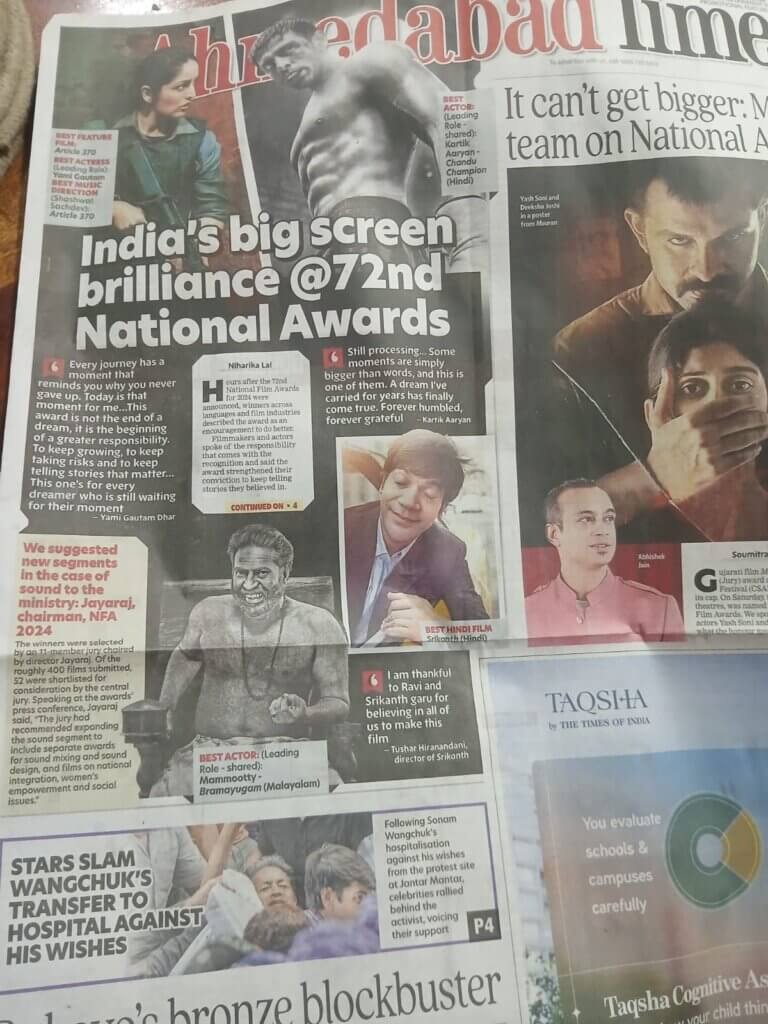
The Times of India, Ahmedabad Edition, 18 July 2026 – Story carried on an inner page.
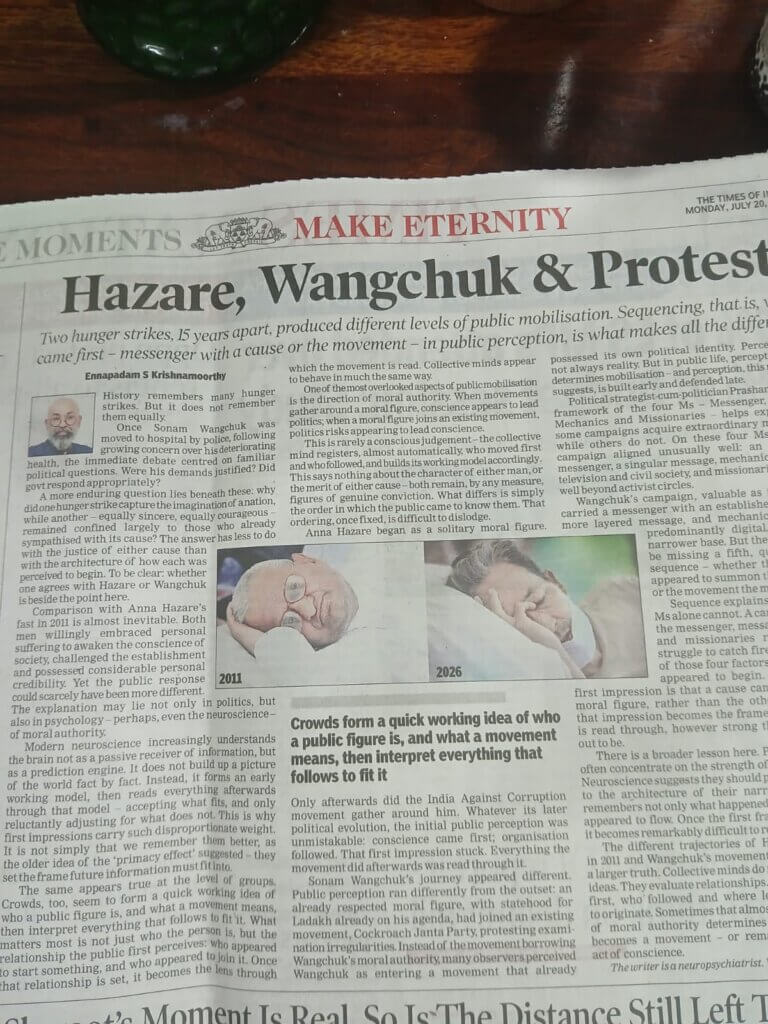
The Times of India, 19 July 2026 – Story moved to the front page.
Sonam Wangchuk remained on an indefinite hunger strike for 23 days—from June 28 to July 20, 2026—over alleged irregularities in the NEET-UG exam. Yet for much of that period, the protest received remarkably little sustained attention from many mainstream media outlets. It raises an uncomfortable question: why did a prolonged hunger strike by one of India’s most well-known public figures fail to remain in the national conversation?
One reason that drew Sonam Wangchuk to his protest was his expression of solidarity with the innocent students who were protesting.
I was surprised to see reports about his fast only from yesterday. Until then, The Times of India had remained largely silent. Yesterday, what the newspaper seemed to find more noteworthy was the outpouring of Bollywood support, and the story appeared on an inner page of the Ahmedabad Times section. Imagine the importance given to such a significant issue when it is placed alongside entertainment news.
Today, the story made it to the front pages and feature sections. Must someone reach the extreme before their concerns are considered newsworthy?
A Citizen’s Expectations from the Press
As a citizen, I expect journalists and media organizations not to bow down to pressure. They should have the courage to report anything that genuinely concerns the common man.
It is the people who need your voice to express their anger, concerns, and anguish—not politicians. Nobody benefits from biased reporting, neither the country nor its citizens.
This country is not built around a handful of wealthy entrepreneurs or billionaires. It is built on the strong foundation of democracy.
It is time we start rebuilding that democracy, one truthful story at a time.

Leave a Reply