
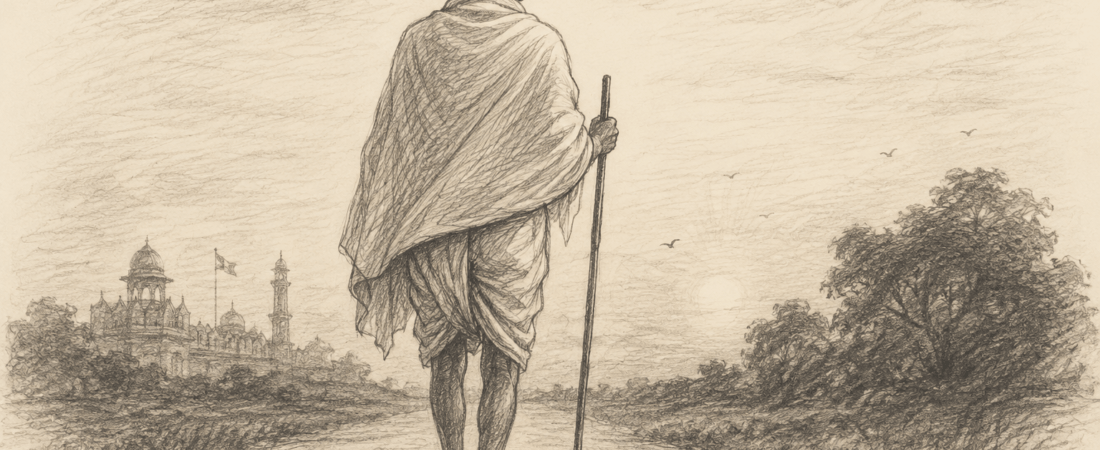
Mahatma Gandhi Is Alive
Yes, you heard me right.
Mahatma Gandhi is still alive.
His ideas, values, and legacy continue to live in the hearts of millions of Indians.
Some people die when they take their last breath. Others never truly die because the world continues to live by what they stood for. Gandhi belongs to the second category. In that sense, he is immortal.
I recently had the opportunity to visit the Sabarmati Ashram, where Mahatma Gandhi lived and worked during some of the most defining years of India’s freedom struggle. Standing in the very place where he held important meetings and made many of the decisions that shaped the nation’s path to independence was a deeply humbling experience.
I was in awe.
It was a deeply humbling experience to be surrounded by so much history and to reflect on the extraordinary legacy of a man whose ideals continue to inspire the world.
January 30, 1948
We believe that on this fateful day, the Father of the Nation was assassinated.
Yes, Mahatma Gandhi was killed. But Gandhi and his ideology were not.
Nathuram Godse, an RSS activist, probably believed that with one act he could bring down a great phenomenon, erasing Gandhi and everything he stood for from the face of India.
Instead, the opposite happened.
I once read that while waiting for execution in Ambala Jail, Nathuram Godse reportedly regretted killing Mahatma Gandhi and said that, if given a chance, he would work for peace. Whether that remorse was genuine or simply an attempt to escape the gallows, only he knew. It’s very hard to believe a man who seldom showed any remorse.
It Only Immortalized Gandhi
Rather than ending Gandhi’s influence, his assassination made him immortal.
Today, it is not just India but the entire world that looks up to Gandhi and his words for inspiration.
His principles of truth, non-violence, forgiveness, and peace continue to inspire leaders, activists, students, and ordinary people across generations.
You can kill a man.
You cannot kill an idea.
He Was a Christian in His Deeds, Though Not by Faith
Although Mahatma Gandhi was not a Christian, he deeply admired the teachings of Jesus, especially the values expressed in the Sermon on the Mount. He believed that principles such as love, forgiveness, humility, and nonviolence had universal relevance and sought to live by many of them. In many ways, his life and public witness drew renewed attention to these Christian teachings in India, even among people of other faiths.
He Deserved the Nobel Peace Prize
Like many remarkable people who have received the Nobel Peace Prize, Gandhi was equally deserving of this prestigious honour.
I’m not sure what prevented it from happening.
Perhaps he never had the time to dream about awards.
He was too busy serving his country, right until his final moments.
Whether he received the Nobel Prize or not does not change his place in history.
Albert Einstein Said It Right
Albert Einstein once said that future generations would scarcely believe that such a man ever walked the earth in flesh and blood.
How true those words are.
A simple, frail man, dressed in nothing more than a dhoti, had millions following him and his ideals. Without violence, he challenged one of the greatest colonial powers the world had ever seen.
Very few people in history could have achieved what Gandhi did.
Gandhi is a towering phenomenon that cannot be erased, no matter how many history books remove him or how many buildings are renamed.
Gandhian ideology
Gandhian ideology isn’t just something we read about in history books. It is a way of life built on truth, nonviolence, compassion, simplicity, and justice. Gandhi believed that real strength comes from patience, forgiveness, and the courage to stand up for what is right without resorting to violence. Even today, his ideas continue to inspire millions, reminding us that while a person may leave this world, their values can live on forever.
A Prophet Is Never Welcomed in His Own Town
Just as Jesus said, “A prophet is not without honor except in his own town.”
I have often felt the same about Gandhi.
The people of his own state do not always celebrate him as much as other parts of India. I have personally seen the admiration for Gandhi in states like Kerala, where his ideals continue to be remembered and respected.
Whether people celebrate him or not makes little difference.
Gandhian philosophy has crossed states, countries, and generations.
He Was Simply Unbelievable
Gandhi had a great mission to accomplish, and he accomplished it.
People may continue to interpret his life and decisions differently, but one fact remains—he achieved what many thought was impossible.
He stood against one of the world’s greatest colonial powers, not with weapons or violence, but through peace, dialogue, fasting, self-discipline, and moral courage.
That is not something ordinary people can do. It takes someone extraordinary.
A frail man on the outside, but an iron man within.
That was Mahatma Gandhi.
Generations to come, will scarce believe, that such a man as this one, ever in flesh and blood walked upon this earth.
Albert Einstein
Why Was He Assassinated?
Why was a 78-year-old man, revered by millions, killed?
It was, in many ways, an enduring consequence of the colonial tactic of “divide and rule.” After making enough inroads, the colonial powers succeeded in dividing people along religious lines.
Being a staunch Hindu radical, Nathuram Godse believed Gandhi cared more for Muslims than Hindus. Somewhere, he felt that, in the end, India would suffer because of Gandhi’s actions.
But today, when I look back, neither the assassin nor his actions were right. We now understand that neither partition nor the mindset of people could be changed through violence. Much of it remained the same as what the colonial powers had set out to create.
In many ways, it was a tragic misunderstanding in a country deeply divided by the legacy of “divide and rule.”
Perhaps the Only Place He Failed Was His Own Family
We often remember Mahatma Gandhi’s sacrifices for India, but rarely the sacrifices made by his family. His wife and children shared him with a nation and often had very little of him for themselves.
His lifelong commitment to the freedom struggle came at a deeply personal cost. Whether one sees it as a necessary sacrifice or a shortcoming, there is little doubt that his family bore a significant part of the burden while he dedicated his life to serving the country.
Gandhi’s Legacy Lives On
He lives every time someone chooses peace over violence.
He lives every time someone chooses truth over lies.
He lives every time someone forgives instead of seeking revenge.
On January 30, 1948, a man was assassinated. But Gandhi became immortal.

Leave a Reply