
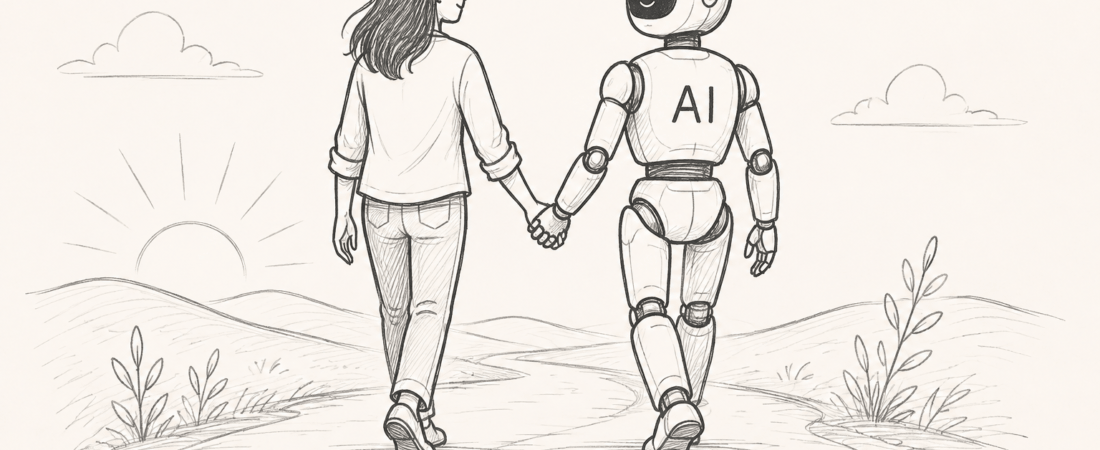
One Day, People Will Get Used to AI Too
There was a time when people were afraid of computers.
Yes, computers.
Today, it is difficult to imagine a workplace without them. We open our laptops before we even finish our morning coffee. We send emails, create documents, analyse data, design graphics, manage businesses and communicate with people across the world—all with the help of computers.
But it wasn’t always like this.
When computers began entering workplaces, there were genuine fears that they would take away people’s jobs. The concern was simple: if a machine can do the work, what will happen to the person doing that work?
Sounds familiar?
Today, we are asking almost the same question about AI.
We have been here before
The fear of technology replacing human work is not new.
When machines began transforming factories during the Industrial Revolution, workers worried about losing their livelihoods. Some even destroyed machines because they believed mechanisation would make their skills and labour unnecessary.
Then came the automobile.
People worried about accidents, disruption and what would happen to those whose livelihoods depended on horses and horse-drawn transport.
Photography created another kind of anxiety. Portrait artists could reasonably wonder whether a camera would make their profession irrelevant.
Then came ATMs.
People feared that banks would need fewer human tellers.
The internet brought another wave of uncertainty. Newspapers, travel agents, retail stores and many other businesses had to rethink how they operated.
And now we have AI.
The technology has changed.
The fear hasn’t changed much.
But humans have never stopped working
The interesting thing about all these innovations is that humans did not simply stop working.
Work changed.
Some jobs disappeared. Some tasks became automated. Some professions became smaller. But new roles, industries and opportunities emerged.
And perhaps more importantly, humans learned to use the technology.
Computers didn’t replace the human being.
Humans learned to work with computers.
A graphic designer who once worked entirely with paper and physical tools eventually learned design software.
An accountant who once maintained ledgers learned spreadsheets and accounting software.
A photographer who once worked with film learned digital photography and editing.
A marketer who once relied heavily on print advertising learned websites, search engines, social media and analytics.
The tool changed.
The person adapted.
Perhaps AI will follow the same path
Right now, AI can feel different.
It can write.
It can create images.
It can analyse information.
It can generate code.
It can summarise documents.
It can answer questions in seconds.
And because AI appears to perform tasks that we traditionally associate with human intelligence, the fear around it can feel much bigger than the fear surrounding an ordinary machine.
But perhaps we are looking at it from the wrong angle.
Instead of asking only:
“Will AI take away my job?”
Maybe we should also ask:
“What will my job look like when AI becomes normal?”
That is a very different question.
The computer didn’t make humans useless
Think about what happened when computers became common.
A computer could calculate faster than a person.
It could store more information.
It could process repetitive tasks without getting tired.
It could produce documents much faster than someone working manually.
Yet we didn’t conclude that humans were no longer needed.
Instead, we started expecting more from people.
We learned how to use computers.
We created new jobs around them.
We developed new skills.
Entire industries grew around technology that once seemed intimidating.
Today, a young person using a computer at work isn’t considered particularly technologically advanced.
It is simply normal.
That is what happens when technology becomes familiar.
AI may become just another tool
Perhaps one day, children will grow up wondering why we were so worried about AI.
They may find it strange that people once debated whether AI should be used to write, design, research or analyse information.
For them, asking AI for assistance may be as ordinary as opening a browser is for us.
That doesn’t mean AI won’t cause disruption.
It will.
Some tasks will disappear.
Some jobs will shrink.
Some professions will change dramatically.
And people who refuse to learn new ways of working may find themselves struggling.
But disruption is not the same as the end of human work.
The automobile didn’t eliminate transportation jobs.
The computer didn’t eliminate human workers.
The internet didn’t eliminate business.
And the smartphone didn’t eliminate communication.
They changed them.
The skill may be adaptation
Perhaps the biggest lesson from previous technological revolutions is not that technology never takes jobs.
It does.
The lesson is that human beings are remarkably good at adapting.
The person who learns to use a new tool can often do more than the person who refuses to use it.
That was true with computers.
It was true with the internet.
And it may be true with AI.
The future may not belong to people who compete against AI at everything.
It may belong to people who understand where humans are better and where machines are better—and know how to bring the two together.
AI can generate.
Humans can question.
AI can process.
Humans can judge.
AI can produce possibilities.
Humans can decide which possibilities are worth pursuing.
That relationship is still evolving.
One day, AI may not feel like AI anymore
There was a time when using a computer felt like using advanced technology.
Today, we hardly think about it.
We don’t say, “I am using computer technology” every time we send an email.
We simply send the email.
The same thing may happen with AI.
At some point, we may stop talking about “using AI” because AI will simply be built into the tools we already use.
A marketer may use AI without thinking of it as an AI task.
A teacher may use AI to prepare lessons.
A designer may use AI as part of the creative process.
A doctor may use AI-assisted tools alongside professional judgement.
A business owner may use AI to analyse information before making a decision.
The technology may become invisible.
The work will remain human.
We don’t know exactly what comes next
I don’t think we should pretend that AI is harmless or that every technological change automatically creates more jobs.
There will be real disruption.
There will be people who lose jobs.
There will be skills that become less valuable.
There will also be new opportunities that we cannot yet fully see.
That uncertainty is uncomfortable.
But perhaps uncertainty is also what every generation has faced when something new arrived.
Our grandparents couldn’t have predicted today’s digital economy.
People working in the early days of computers couldn’t have imagined social media managers, SEO specialists, app developers, YouTubers, AI engineers or digital creators.
Many of today’s jobs simply didn’t exist in the way they do now.
Tomorrow will probably be the same.
So, should we be afraid?
Maybe we should be cautious.
Maybe we should learn.
Maybe we should question how AI is being used and make sure technology serves people rather than the other way around.
But fear alone won’t stop technological change.
The better response may be to understand it.
Learn it.
Experiment with it.
Use it where it genuinely helps.
And, most importantly, continue developing the qualities that make us human.
Curiosity.
Judgement.
Creativity.
Empathy.
Responsibility.
Common sense.
The ability to understand another person.
Because technology may become incredibly powerful.
But humans will still have to decide what to do with that power.
One day, people will get used to AI too.
Just as they got used to computers.
And perhaps when that day comes, we will look back at today’s fear and realise that AI did not simply replace the way we work.
It changed the way we work.
And humans, as they have done many times before, learned to change with it.

Leave a Reply