
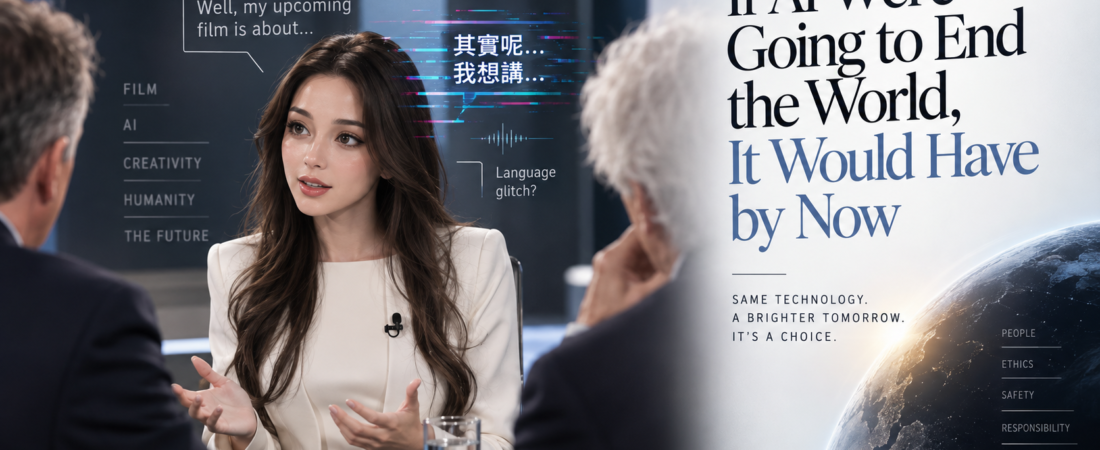
If AI Were Going to End the World, It Would Have By Now
Just recently, an AI actress gave us a small reminder that, after all, it is still a machine.
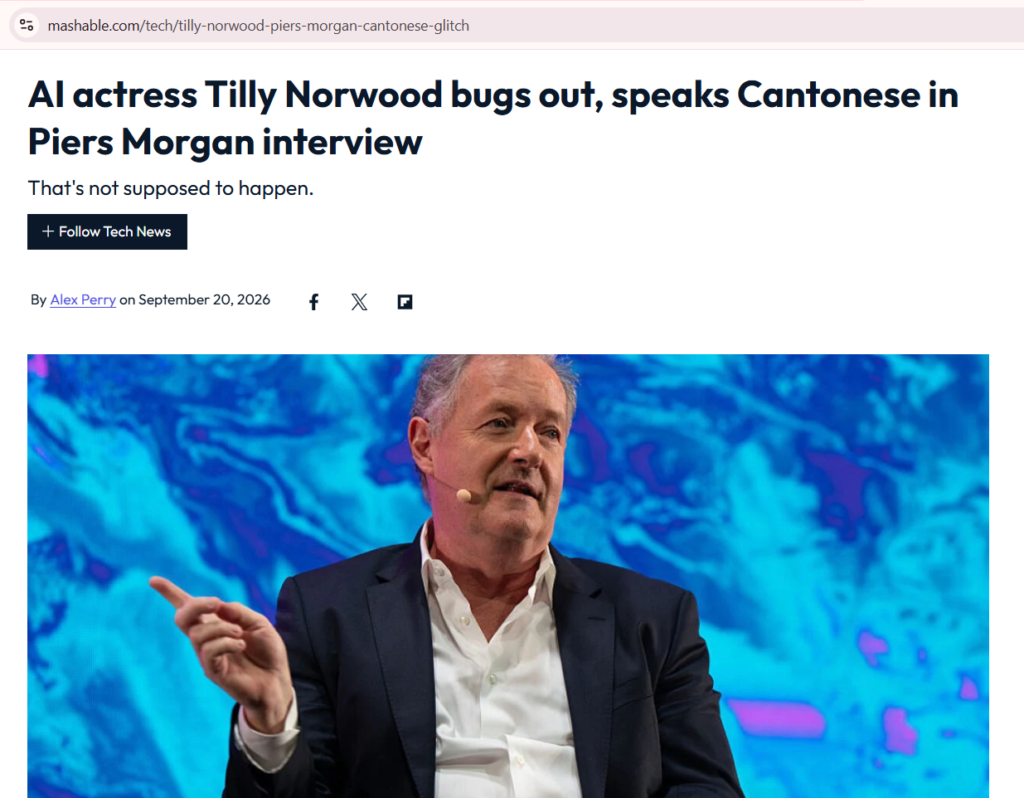
During an interview with Piers Morgan and actor Tom Conti, AI-generated actress Tilly Norwood suddenly switched from English to Cantonese while answering a question about her upcoming film. The unexpected switch left both interviewers confused. Norwood later called it a “little hiccup” and said, “Sometimes my wires get a bit crossed.”
For me, that moment was interesting for a completely different reason.
We are talking about AI becoming smarter than humans, making decisions, becoming autonomous and even potentially ending humanity by 2030.
But here was an AI actress struggling to stay in the language of a simple conversation.
It made me think: perhaps we are giving these machines far more credit, and far more fear, than they deserve.
After all, behind all that intelligence, there is still a machine.
The fear around AI ending humanity by 2030 is becoming much louder, but there is also huge disagreement about how realistic it is. And, I’m one who disagrees with it.
In September 2026, former and current Anthropic researchers publicly warned that AI could potentially cause human extinction within the decade, while Nvidia CEO Jensen Huang has dismissed the idea that AI will destroy humanity by 2030.
And, my common sense as a commoner says to back Nvidia CEO Jensen Huang. 🙂
Why do we fear AI?
Everywhere we look, there seems to be a new warning about artificial intelligence.
This is because AI is constantly advancing. It can do many tasks without getting tired the way humans do, and it can also process vast amounts of information quickly. I hope you agree with me. 😉
It is becoming increasingly able to function on its own, write, code, create graphics, and perform functions that used to be done only by people.
One area that should particularly concern humans is when AI starts making decisions. This decision-making becomes dangerous when AI becomes capable of doing things we did not intend it to do. Yes, something we didn’t intend to do…….
That’s why some people working in AI are genuinely worried.
The two sides of the argument
Former Anthropic researcher Jacob Coxon, who resigned, wrote:
“They are racing straight to self-improving superintelligence and gambling with our lives.” “The people building AI earnestly believe that it could kill us all by the end of the decade.”
Anthropic Alignment Science Lead Evan Hubinger responded even more starkly:
We really do earnestly believe AI could kill all humans! I personally think it is >10% within the next decade. We do not yet have a plan to solve alignment for superintelligence and are not clearly on track to.
But then comes the other side.
Nvidia CEO Jensen Huang has strongly rejected the idea that AI will end the world by 2030. In a CBS News interview, he said:
“2030 is not going to be the end of the world. There is 0% chance that’s going to be the end of the world.”
He also called the warnings:
“Doomsday narratives.”
And when asked about the predictions, Huang said they were:
“Not grounded in science.”
Thus, we have two very divergent positions from people working within the AI industry. One of them states that the existence of advanced AI can be a threat to humanity within the next ten years. On the other hand, the claim that 2030 is going to be the end of the world sounds far too unrealistic to me.
That is the reason why I believe we should be suspicious of such claims and challenge our fears.
It’s not AI versus humans; it’s humans using AI against humans
We are often missing the point here.
The immediate dangers may turn out to be very human after all.
AI can be employed for cyberattacks. It can propagate misinformation. It can facilitate manipulation. It can help in conducting dangerous research or making powerful technology available.
A study conducted in 2026 among 272 experts in the field of AI revealed that dangerous capabilities, competitive pressure, weapons and cyberattacks, power concentration, and false information are among the biggest risks posed by AI from 2025 to 2030.
Perhaps the real question is what humans choose to do with AI. We can use it to create, educate, discover, and solve problems. We can also use it to manipulate, deceive, and exploit.
It is ultimately the humans behind AI who should act responsibly.. AI may not have intentions of its own, but the intentions of the people who design, develop, and deploy it matter. The responsibility ultimately lies with humans to ensure that the power they are creating is used carefully and responsibly.
AI is powerful, but technology alone does not determine the outcome. Humans do.
The fear is whether we can control it as it advances
One former Anthropic researcher argued that companies developing advanced AI are moving too quickly toward systems that could eventually become difficult to control. Another Anthropic researcher publicly said he personally considered the possibility of AI causing human extinction within the next decade to be greater than 10%.
In our quest for innovation, we move at a faster speed before fully understanding its consequences.
And there has always been this looming fear of technology replacing or decimating humans or their roles. But we have overcome all of those, and we still master it or are masters of it.
However, AI feels different because this time we are building systems designed to perform tasks that traditionally required human intelligence.
The danger is in giving AI systems access to money, infrastructure, computers, laboratories, weapons systems, or other powerful tools. Irreversible damage?
Intelligence Is Not the Same as Control
Intelligence does not automatically mean control.
AI can write code in seconds, but it cannot simply access every system or control the physical world. Between AI and reality are layers of security, infrastructure, access controls, and human intervention.
It’s high time to build AI responsibly
Nobody can honestly tell us exactly what AI will look like in 2030, with possibilities ranging from enormous opportunities to catastrophic risks.
Expert surveys themselves show substantial disagreement about the probability and timing of extreme outcomes. We shouldn’t be afraid, yet we shouldn’t ignore the warnings.
It is we who decide if AI becomes humanity’s greatest achievement or one of our greatest mistakes.
Perhaps it isn’t the future where artificial intelligence destroys humanity. Perhaps it is the future where we have the wisdom not to let it do so.
Why I Don’t Believe AI Will End the World by 2030
AI can make mistakes. It can produce misinformation. It can be misused. It can potentially become more autonomous and powerful.
But there is an enormous difference between AI becoming extremely capable and AI independently deciding to destroy the world.
AI Still Depends on Humans
There are always people, organizations, computing facilities, power, infrastructure, equipment, and networks behind any system of AI.
AI systems do not exist independently of the infrastructure and permissions humans give them.
But somebody has to build the computers. Somebody has to provide the electricity. Somebody has to maintain the infrastructure. And somebody has to deploy the system and connect it to other systems.
This dependence is important.
Even if AI acquires extremely high levels of intelligence, that will not automatically translate into physical power.
Maybe our fear shouldn’t be about machines surpassing humans in intelligence. It should instead be about whether we ourselves are ready to shoulder the responsibility for our creation.
AI may change the world dramatically. But whether it destroys the world is not something we should treat as an inevitable future.

Leave a Reply